
Life in China
Read First
In Gulun Kung Fu, you have the rare combination of deep, internal depth and clear communication and organisation.
This is Ben Lucas writing. I've been living in China for nearly three years. If I had received this guide before arriving, it would have saved me at least 20 hours of messing around. If you check off this list, you will make an excellent first impression on me.
Please take these steps before you arrive. In particular, steps relating to SIM card, VPN (Let’s VPN is the best) and payment are easier to take at home than after you arrive.
If you have questions, email Li Juan at wugulunacademy@hotmail.com or me at ben@benlucas.co. We're here to help make your China experience smooth and enjoyable.
Getting Here
The address: 会善寺西800米路北800米古轮禅院. You can also search ‘Gulun Chanyuan’ on Didi.
It is a 90-minute taxi ride from Zhengzhou Airport. Use Google Flights or Skyscanner to find the best route to Zhengzhou – likely via a major Chinese city.
Alternatively, you can fly directly from some European cities such as London to Wuhan and then take a train to Zhengzhou without a connecting flight. The Chinese train system is excellent – cheap and reliable. Book via a website such as trip.com.
To book a taxi, the cheapest and easiest way is to copy-paste the address above into a ride-hailing app such as Amap or Didi.
This will cost around 200 RMB. Taxi drivers will likely ask you to pay an additional amount of around 50 RMB above the fare stated in the app to cover a road toll (‘gao su fei’). Don’t worry – they’re not trying to rip you off!
If you hail a taxi, it will likely cost around 300 RMB.
Contacts and Addresses
Two years of local knowledge in one document.
Download our guide to Dengfeng — massage places, taxi drivers, supermarkets, hospitals, acupuncturists, restaurants, saunas, tea houses, and more. Includes clickable Amap links and WeChat contacts you can add directly.

Staying Here
Rooms are equipped with air conditioning and hot water.
You stay in a clean, modern dormitory for a maximum of four people. It would be unusual for there to be more than two others in your room.
Regarding food, vegetarian and non-vegetarian options are available. A 20-minute walk away, there is a shop where you can buy fruit and other food.
Outside Accommodation
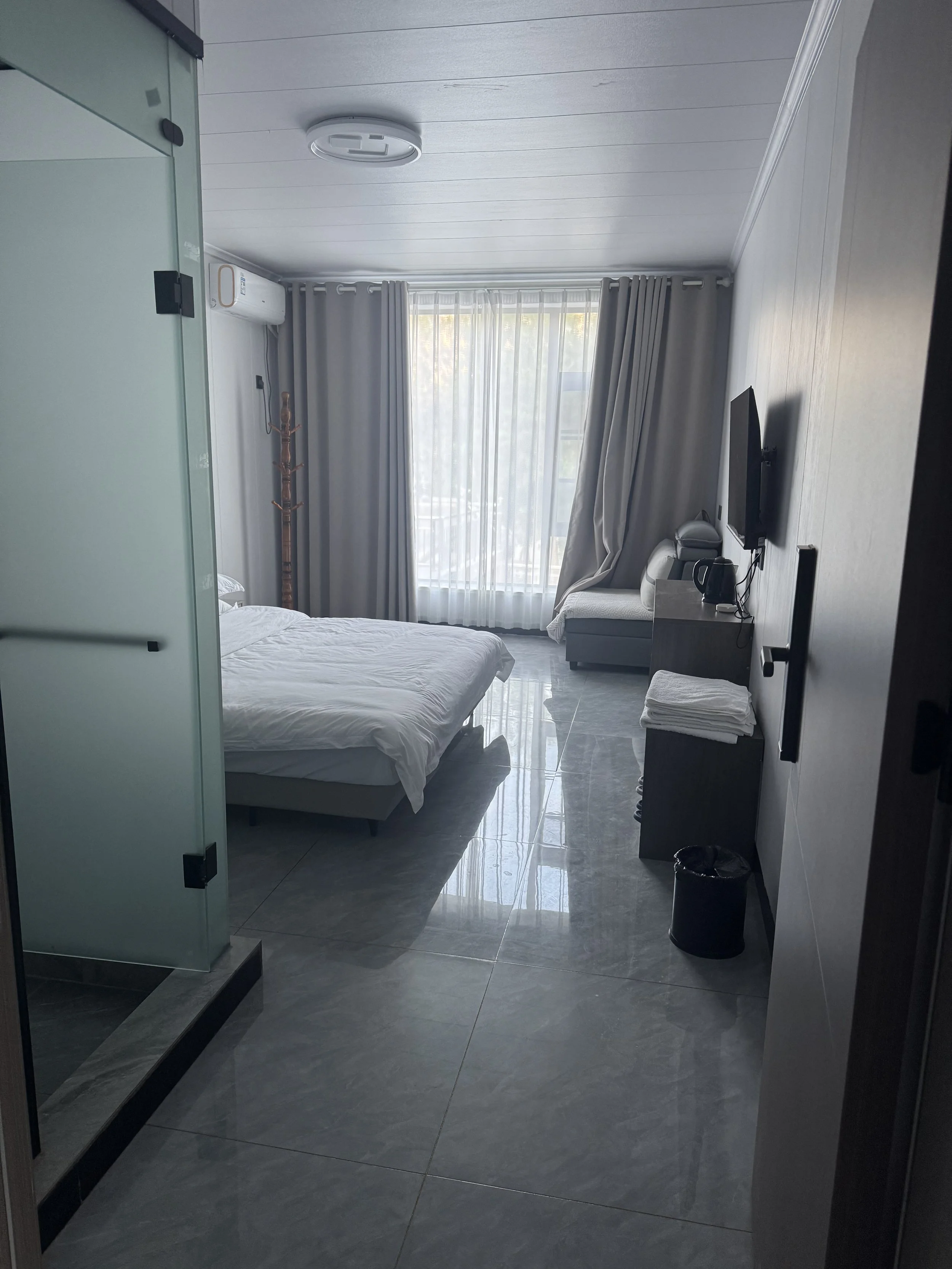
If you prefer to stay in a more comfortable single room, we can arrange for you to stay in a nearby hotel that is a serene 20-minute walk from the our academy. See first photo on the left below. The fees for this hotel are 3,500 to 4,000 yuan per month (depending if you choose to include breakfast, dinner, and/or laundry.) The daily rate is pro rated accordingly (about 117-133 yuan per day).
A third option is an apartment building 5km from the academy. See rates and second and third photos on the right below. You would need to take a taxi to the academy and back (about 15-20 yuan each way). You could also rent an electric scooter for 50 yuan a day or buy one second-hand for about 1,500 yuan.
Apartment Nightly Rates
1 Bedroom / 1 Living Room
1–2 days – ¥280
7+ days – ¥196
30+ days – ¥112 (~¥3,360/mo)
90+ days – ¥98 (~¥2,940/mo)
2 Bedrooms / 1 Living Room
1–2 days – ¥380
7+ days – ¥266
30+ days – ¥152 (~¥4,560/mo)
90+ days – ¥133 (~¥3,990/mo)


Price
Fees include training, food and accommodation, and are as follows:
| Duration | Price |
|---|---|
| 1 day | 350 yuan |
| 1 month | 7000 yuan |
| 2–3 months | 6500 yuan |
| 4–6 months | 6000 yuan |
| 7–9 months | 5500 yuan |
| 10+ months | 5000 yuan |
If you choose to stay in accommodation outside of the school, then the fees are reduced by 500 yuan per time frame (reduced by 50 yuan for 1 day).
Your total is based on the rate for your full commitment. For example: 6 months × 6,000 yuan = 36,000 yuan total. You can pay in instalments, with each instalment charged at the corresponding rate from the table above. Paying monthly: 7,000 yuan per instalment. Paying every 2 months: 6,500 yuan × 2 = 13,000 yuan per instalment. Each payment is deducted from your balance until it's cleared. Your final payment will be the remaining balance.
Essential Apps
Download before you leave:

Visa
The visa process for China is straightforward.
Short stays (under 30 days): Tourist visa (L visa). Note: Some nationalities can enter China without a visa for 30 days. Check online.
Medium stays (1-3 months): Cultural exchange visa (F visa)
Longer stays (up to 6 months): Study visa (X2 visa). (Please note that the school currently cannot process 1-year study visas (X1), but you can apply for another X2 visa when your first one expires.)
Note: Not all embassies accept kung fu schools for X2 visas. However, I successfully obtained X2 visas from Britain, Thailand, Sri Lanka, Japan and Taiwan but was rejected in Hong Kong.
Some countries offer 2-year multiple entry visas (e.g., Britain)—unlimited entries, max 120 days per stay.
How to apply:
Follow these visa application instructions (please search online for the most current form) and fill out this template invitation letter for a tourist visa. For a study visa, here is a sample template admission letter that you can fill out and email to Li Juan, but please note she may need to adjust the letter according to requirements that change from time to time. Then send them to Li Juan at wugulunacademy@hotmail.com. Copy ben@benlucas.co on the email if you like as Li Juan’s English isn’t perfect
Include: gender, visa type, dates, passport number
Check the requirements carefully and ensure you have all documentation before your visa appointment
If you want to stay long-term, you can do so easily by leaving the country to get a new visa before coming back. You can stay indefinitely using this strategy.

SIM Cards & Internet
Option 1: eSIM (Simple)
Download an eSIM before arrival such as Ubigi or Airalo.
Download before arriving or through Alipay once here.
Foreign eSIMs bypass VPN requirements. Examples: Ubigi, Airalo, Trip.com (cheaper than the other two - search for “eSIM” in app or website for package options and pricing).
Drawback: You will not have a local phone number for taxi apps, receiving SMS verification codes and installing WeChat. So if you plan to get an eSIM, install WeChat before you come.
Option 2: Local SIM (Cheaper but tricky)
Hit-and-miss for short stays—they don't always allow short-term visitors to get SIM cards. Ben can probably sort you out (I'm friends with telecom company staff), but eSIM is more reliable. If you will stay longer, it is very helpful (and sometimes necessary) to have a local mobile number.
VPN
Foreign websites like Google, Facebook, Instagram, and possibly your bank are blocked in China. You need a reliable VPN to access these websites.
If you don’t download an eSIM, download one of these BEFORE arriving to access Western media:
Let's VPN (letsvpn.world)
Ladder VPN (laddervpn.live)
Roo VPN (iOS app)
Avoid the most popular VPNs (e.g., Express, Nord, and Surfshark). They are expensive and unreliable in China.

Money
Everyone uses QR code payments in China.
You cannot use physical foreign cards to make payments.
So, before arriving:
Download WeChat and Alipay (ensure back-up)
Link your bank card (if you have multiple cards, add all of them as there can be security issues)
Alipay: Account > Bank Card > Add Bank Card
WeChat: Me > Services > Wallet > Bank Cards > Add Bank Card. Note that you may need to upload your passport details before you can use this service, and verification can take up to 24 hours.
Modern banks (Wise, Revolut) work without issues. Notify old-school banks about China travel before you arrive – many foreign guests have had issues with old-school banks blocking payments in China. You can set up an account with Wise or Revolut very quickly.
Cash exists but is rare.
ATMs now all accept foreign cards.

Summary: Pre-Departure Checklist
Essential Steps
Download apps: WeChat, Alipay, Google Translate, Amap, Didi China
Link your bank card to Alipay and WeChat. Notify bank of China travel if your bank is old school
Download eSIM or VPN (before arriving!)
Email Li Juan at wugulunacademy@hotmail.com for visa invitation letter. Her telephone number in China is: 15937138860
Save school address in Chinese on phone: 会善寺西800米路北800米古轮禅院
Nice to Have
Download Taobao for shopping
Download EZ Screen Translator (iPhone)
Learn to say "hello" and your country in Chinese
Questions? Email Li Juan at wugulunacademy@hotmail.com or Ben at ben@benlucas.co. We're here to help make your China experience smooth and enjoyable.
For your convenience, here is a zip file of all the downloadable files on this page:
Chinese for Kung Fu
Many people come out here to China and want to learn basic Chinese so they can understand what Shifu and the teachers are saying. I've made this set of 140 flashcards covering both survival/daily life and kung fu principles and key vocabulary, so you can follow what the teacher is saying in class.
If you learn 2 per day, in three months you'll understand about 70% of the basic instructions given here.
I've used AI to create a mnemonic for each flashcard. A mnemonic is a memory hook — it links the sound of the Chinese word to the English meaning through a vivid image or phrase. For example:
放松 (Fàngsōng) — Relax A fang drops out of a snake's mouth mid-song — even serpents relax to music.
The sound "fàng sōng" is hidden inside "fang" and "song", and the image gives you the meaning. The weirder the picture, the faster you remember.
How to Use
Download Anki (free): https://apps.ankiweb.net
Download the Anki file attached to below
Open Anki → File → Import → select the file
Also attached below is a PDF with all the vocabulary.
If you are serious about learning Mandarin, in particular studying Chinese characters, the Mandarin Blueprint is the best resource.

Misconceptions About China
China has become much easier for foreigners in recent years. Contrary to popular belief, it's one of the least bureaucratic and most relaxed countries I've been to.
Attitudes to Foreigners: It's far more common for people to give me discounts, waive fees, or refuse payment entirely than to try to overcharge me. It's absolutely not the case that people are trying to take advantage of foreigners. If you can say "nǐ hǎo" (hello) and your country name in Chinese, people will explode with excitement and tell you your Chinese is amazing.
China is actually much safer than Europe. There's virtually no crime, drunkenness or no aggressive behaviour in China. The culture is more reserved and friendly—people aren't trying to one-up each other or compete to be the coolest. Instead, there's a genuine effort to make others feel comfortable. Personally, I feel much less threatened and more at home here than in Europe. While China has different customs and ways of communicating, people understand that Westerners are different and are very accommodating. Don't worry too much about messing up etiquette.
Cost of Living:
Dengfeng and Songshan are among the cheaper areas in China. Your money goes a long way.
Food: A meal out costs around 10-30 RMB (80 if you want to splurge) . Supermarket prices are roughly half what you'd pay in Western Europe.
Transport: A taxi across town is about 15-20 RMB. An electric scooter costs around 1,500 RMB — then nothing, because you charge it yourself. Trains are fast, frequent, and reliable. From here to Shanghai is about 500 RMB.
Healthcare: Roughly 5–10 times cheaper than Western Europe, with very little waiting time or bureaucracy. I've had dental treatment, laser eye surgery, and hormone testing here — all at a tiny fraction of Western prices.
Massage: Two options. The budget route: 60–80 RMB, where a stocky Chinese man beats the tension out of you whether you like it or not. The luxury route: 200–400 RMB for a proper spa — private room, complimentary food, essential oils, and a gentler touch. Choose according to your pain threshold.
Sauna: Our favourite spot looks like a five-star hotel. Entry is 39 RMB.
Acupuncture: A practitioner near the academy does acupuncture, cupping, massage, and scraping — about 80 RMB per session.
Shopping: Clothes in local shops are only slightly cheaper than in the West — a top and trousers cost around 400 RMB. Taobao (China's answer to Amazon, with five times the variety at a fraction of the price) usually has the same thing for half that.
Monthly Budget
Strict budget: Around 2,000–4,000 RMB/month beyond training fees. Eating simply, cooking where possible, local transport, minimal extras.
Comfortable: Around 5,000–7,000 RMB/month. Eating out regularly, the occasional spa massage, weekend trips, Taobao deliveries showing up at the door.
Long-term Stays: Want to stay indefinitely? When your visa expires, simply leave, get a new one, and return. No restrictions. Since living costs are so low, it makes more sense to earn money here than save at home. We're flexible with training schedules if you need to work.
Kung Fu Misconception: People think Chinese are protective about kung fu and don't want foreigners learning. Complete rubbish! Chinese people are thrilled that foreigners want to learn their culture. They're often more excited about Westerners practicing than locals.
Location & Things to Do
The school is located halfway between Dengfeng city and Shaolin Temple—perfect because it's quiet yet convenient. 15 minutes to the city, 15 minutes to the temple.
There are many great spots in town for tea, massage, and general exploration.
With Amap or Didi ride-hailing app, you can easily hop into town for 15-20 RMB. Otherwise, there are regular buses. I bought an electric scooter for €180. This was perhaps the best investment of my life – zipping around the mountains. We can help you easily rent one.
The Sacred Mountain: This is Songshan, the central sacred mountain of China—seen as where heaven meets earth. From ancient Chinese perspective, this was the center of the world. The landscape is vast and sweeping, with dinosaur fossils found throughout. It has powerful yang energy, said to be healing for those who are sick. You can feel why Zen was born here—the energy is ancient and profound.
Nature: Endless stretches of mountain and forest paths where you can lose yourself in quiet contemplation. I know secret spots for swimming in nature. There's a great hike up the main peak with spectacular views.
It's a true feast to wake up on a Sunday morning and think about which incredible historical site to explore. This area is extraordinarily rich in culture and ancient wisdom.
Options
Shaolin Temple
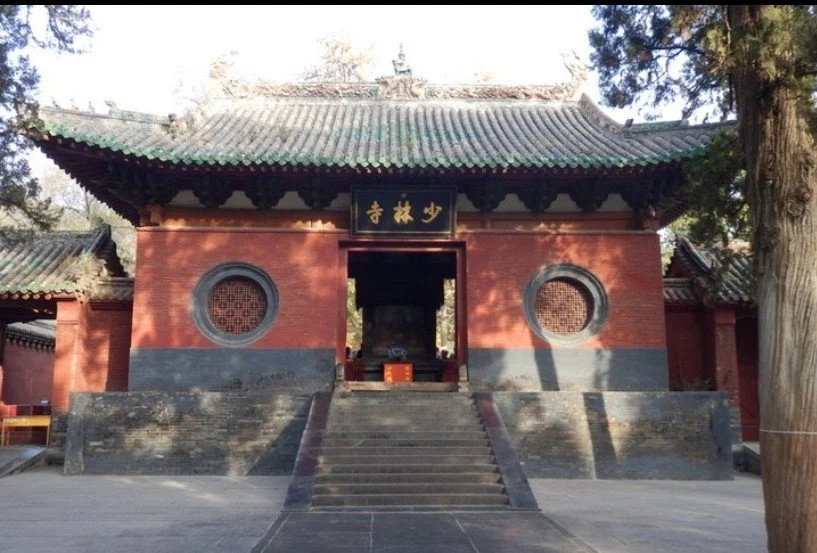
The birthplace of Chan Buddhism and kung fu, just 15 minutes from the school. Best visited early morning to avoid crowds. Walk through the compound to the main temple, then continue up to Bodhidharma's cave for spectacular valley views. Two cable car routes offer different perspectives—one to his disciple's dwelling, another leading to a breathtaking 4km mountain ridge walk ending at San Huang Zhai temple. The walk is challenging but unforgettable.
San Huang Zhai
A newly rebuilt temple on an ancient site, conceived by Master Shi Dejian. This architectural marvel perches dramatically on the mountainside—a spectacular feat of engineering and spiritual vision. Best reached via the cable car and mountain walkway from Shaolin Temple. The journey itself, winding along cliff paths, is as remarkable as the destination.


Fawang Temple
The second oldest temple in China at 2,500 years, built in the 7th century on an even more ancient site. Perched high on Yuzhu Mountain's slopes, it offers sweeping views of Dengfeng. The peaceful grounds and well-preserved buildings reward the climb to the summit. Far fewer tourists make it here, preserving its contemplative atmosphere.

Songyue Pagoda
Constructed in 523 AD during the Northern Wei Dynasty, this is China's oldest brick pagoda and one of the few intact 6th-century structures. Most buildings from that era were wooden and didn't survive. Standing in solitary grandeur about 3km from Fawang Temple, it's a testament to ancient engineering and spiritual devotion.

Songyang Academy
One of China's four great ancient academies, originally built in 484 AD. First a Buddhist site, then Taoist, finally becoming a renowned Confucian center of learning in 1035. While mostly rebuilt, it houses China's oldest tree—a 4,500-year-old cypress honored with military titles by Emperor Wu. Standing before this ancient life puts everything in perspective.

Zhongyue Miao
The largest Taoist temple in Henan Province, with roots stretching back to 700 BC. The current Qing dynasty complex features remarkable Song dynasty iron guards from 1064 and a unique stele depicting China's five sacred mountains. Unlike bustling Shaolin, this temple maintains deep silence—perfect for meditation. A pagoda behind offers panoramic views.

Laomu Dong
An extraordinary Taoist temple that, for me, surpasses even the famous temples of Wudang. The energy here is uniquely powerful—ancient, peaceful, and deeply mystical. Tucked into the mountains, it remains relatively unknown to tourists, preserving its sacred atmosphere. The journey there through winding mountain paths adds to its otherworldly quality.

Gaocheng Astronomical Observatory
A UNESCO World Heritage site where 13th-century Chinese astronomers calculated Earth's orbit around the sun with stunning accuracy—within 20 minutes of modern measurements. Built in 1279 under Kublai Khan, this observatory represents centuries of Chinese astronomical tradition. Standing here, you feel the ancients' dedication to understanding heaven's movements.
Longmen Grottoes
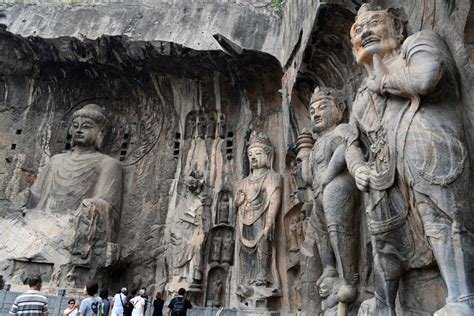
A bit farther afield (2 hours) but absolutely worth it—this UNESCO World Heritage site near Luoyang contains thousands of Buddha statues carved into riverside cliffs. The artistry and devotion carved into stone over centuries is breathtaking.
Weather
Dengfeng is sunny all-year around with very little rain.
It is known as the Yang mountain due to its sunny Yang energy.
The most pleasant times to come are March to May and September to November.
Winter is cold but, for me, due to the sunshine far more comfortable than England.
Summer is hot and humid,